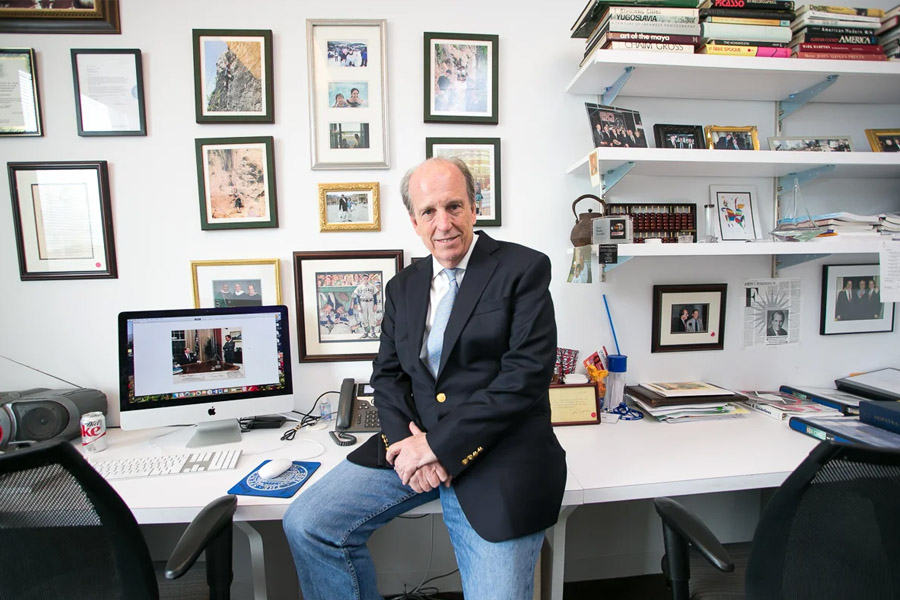
Portrait of a Career
Joseph Felix “Joe” Peyronnin III was born on August 3, 1947 in Chicago. His professional arc reads like a map of modern American television news: long corridors of network control rooms, the electric hum of breaking stories, and later, the quieter light of a classroom. Over more than four decades he moved from producer to executive to founder, and finally to mentor — each phase a different instrument in the same orchestra of storytelling.
A concise snapshot of the man and his work follows.
Basic Information
| Field | Detail |
|---|---|
| Full name | Joseph Felix “Joe” Peyronnin III |
| Born | August 3, 1947 |
| Birthplace | Chicago, Illinois, U.S. |
| Education | B.A. in Radio Broadcasting (Columbia College Chicago, ~1970) |
| Major career phases | CBS News (1970–1995); Fox News (mid-1990s, brief presidency); Telemundo News (founder & EVP, ~1998–2005); Academia & advisory (2008–present) |
| Spouse | Susan Zirinsky (married 1984) |
| Child | Zoë Peyronnin (adopted) |
| Academic affiliations | NYU (adjunct/associate), Hofstra (associate professor, 2011–2019 approx.) |
| Public roles | Trustee / advisor, media panels, Council on Foreign Relations membership |
Timeline & Numbers (Selected Milestones)
| Year(s) | Milestone |
|---|---|
| 1947 | Born in Chicago (Aug 3) |
| ~1970 | Graduated college; began TV news career |
| 1970–1995 | CBS News — producer to senior executive (25-year span) |
| 1995–1996 | Early president-level role at Fox News (short tenure) |
| 1998–2005 | Founded and led Telemundo News (approx. 7 years) |
| 1984 | Married Susan Zirinsky (eloped at the Democratic National Convention) |
| 2008–present | Teaching, advising, and public speaking roles |
The Network Builder
Peyronnin’s name is threaded through three distinct eras of American broadcast news. First, a long apprenticeship and eventual ascent at CBS News across the 1970s, 1980s, and early 1990s. For roughly 25 years he worked in producing and executive roles — time spent at the elbow of evening-news operations and White House coverage — learning the tradecraft of translating raw events into televised narrative.
Then, a brief and consequential stint at Fox News in the network’s formative years. Although his time there was short, it came at a moment when cable news was becoming a force that would reshape political conversation and commercial broadcasting alike. That chapter is part of a larger story about the tectonic shifts in media during the 1990s.
Perhaps the most architectonic achievement is his role at Telemundo News, where, beginning in the late 1990s, Peyronnin led the effort to build a Spanish-language news operation from the ground up. Over roughly seven years he helped scale an editorial and operational framework that moved Telemundo from niche presence toward national competitiveness — a practical study in how network infrastructure, staffing, and editorial strategy must align to serve a growing and diverse audience.
Teacher, Mentor, and Advisor
After decades in the high-pressure engine rooms of broadcast networks, Peyronnin traded the newsroom’s adrenaline for the classroom’s careful light. Beginning in the late 2000s he took on adjunct and associate professor roles at institutions including New York University and Hofstra University, where he taught journalism, advised student news operations, and mentored younger reporters and producers.
Teaching is a form of echo: the skills of producing, ethical judgment under deadline, newsroom logistics, and editorial leadership are transmitted to cohorts of students who will carry the craft forward. Peyronnin’s transition to academia is less a retirement than a reallocation of influence — from shaping nightly newscasts to shaping future journalists.
Family in the Frame
Family life for Peyronnin has been paired with another prominent newsroom figure: his spouse, Susan Zirinsky, herself a long-time producer and network executive. The couple married in 1984, reportedly in an elopement at the Democratic National Convention. Their partnership spans both personal and professional spheres; two seasoned newsroom minds under one roof, trading notes about editorial judgment and the unwritten pressures of live television.
Their daughter, Zoë, adopted from China, has pursued creative and visual fields, representing the quieter, personal consequences of a life lived in public work. Peyronnin’s parents — Joseph F. Peyronnin (senior) and Dorothy Hargreaves Peyronnin — anchored an upbringing in Deerfield, Illinois, that led a young man toward radio broadcasting and ultimately to television.
A short, factual family table:
| Relation | Name | Noted detail |
|---|---|---|
| Spouse | Susan Zirinsky | Married 1984; fellow news executive |
| Child | Zoë (Zoe) Peyronnin | Adopted daughter; works in creative/photography |
| Father | Joseph F. Peyronnin (Sr.) | WWII veteran; construction executive |
| Mother | Dorothy Hargreaves Peyronnin | Family biographical presence |
Public Voice & Recent Visibility
Even after stepping back from day-to-day network leadership, Peyronnin has remained a visible voice on questions of media ethics, newsroom evolution, and the history of cable news. He participates in panels, guest lectures, and interviews. In the 2020s he appears in documentary interviews and industry retrospectives; his commentary is often called upon to explain how decisions were made when the terrain of television news itself was changing.
Numbers here are modest but telling: four decades of active newsroom work, roughly seven years building Telemundo News, and more than a decade of teaching and advising. Those are not just numbers; they are chapters that show a pattern — incremental, cumulative, and durable.
Style, Influence, and Legacy
Peyronnin’s career reads like a ledger of practical competence. He is not the kind of figure who dominates headlines with personality; rather, his influence is institutional: structures built, teams trained, editorial routines established. Think of a newsroom as a cathedral: producers and anchors conduct the liturgy, but executives like Peyronnin lay the stone and choose the architectural plan.
His work at Telemundo, in particular, illustrates a skill set that combines logistics with cultural attention — creating a news operation that can meet linguistic and audience needs is as much about hiring and training as it is about editorial choices. In classrooms he has become the kind of instructor who can hand students a blueprint and then watch them learn to carry it out under pressure.
The narrative threads — Chicago origins, long CBS tenure, a short and stormy cable news episode, the building of Spanish-language news, and then teaching — make for a biography that is at once emblematic of late 20th-century American journalism and oddly personal: a life spent shaping how other people’s stories get told.